Flying ants
Why flying ants swarm on warm summer afternoons, what it means when they come out inside, and how to deal with the nest afterwards.
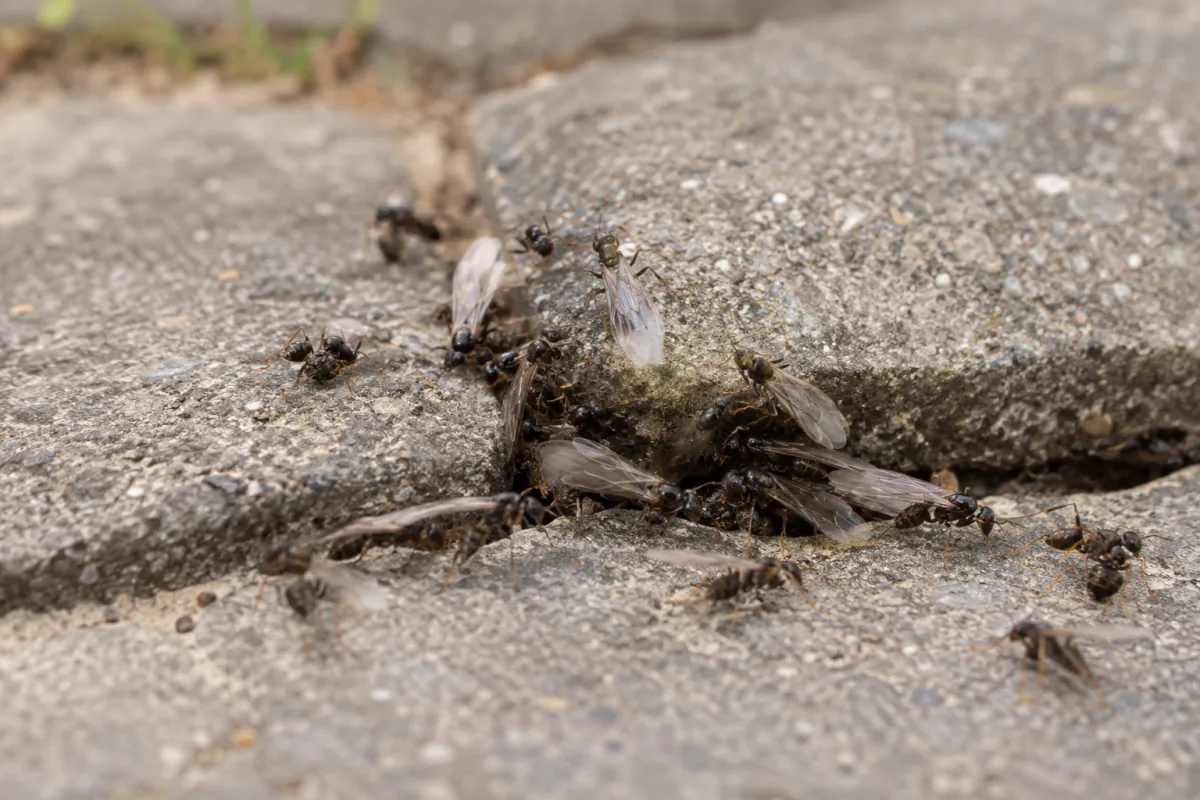
On a warm, sticky afternoon in July or August, paving stones, walls and windowsills across London can suddenly swarm with winged ants. Gulls circle low over the rooftops picking them out of the air, and a few hours later most have gone. It looks alarming, especially when they come out inside the house, but it's a normal part of a garden ant colony's year. What matters is where they came from.
What flying ants are
Flying ants aren't a separate kind of ant. They're the winged queens and males of an ordinary black garden ant nest, raised once the colony is big enough, usually after a few years. The workers you see on the kitchen worktop never get wings.
- Queens are much bigger than workers, around twice the length, with a heavy body.
- Males are smaller and slimmer, with a small head and large wings for their size.
They leave the nest together to mate in the air. Afterwards, the males die within a day or so. Each mated queen lands, breaks off her wings and looks for somewhere to dig in and start a new nest. That's why you often see large, wingless ants wandering about, and loose wings on sills and paths, the day after a flight. Most new queens are eaten or fail to start a nest.
Why they all come out at once
Nests release their winged ants when the weather is right: warm, humid and still, often after a spell of rain. Because the same weather affects thousands of nests at once, they all fly on the same few afternoons. That's what people call flying ant day.
In reality, it's rarely a single day. Surveys of sightings across the UK have shown flights spread over several weeks, with each area's nests flying when their own local weather is right. The same nest can also send out more than one batch over a few days.
Flying ants inside the house
A few winged ants on the windowsill next to an open window have probably just flown in, and aren't a concern.
It's different when they pour out of a gap indoors, for example:
- between floorboards or along the edge of the skirting
- from under the kitchen units or the bath panel
- around a door frame, a window board or an airbrick
- from a crack in a solid floor, often in an extension or conservatory
That means the nest is in or under the building: in the soil beneath a floor, in a wall cavity or under the slab of an extension. The flight is only the visible part. Those same nests usually send foraging workers into the house too, often into the kitchen each spring.
What to do on the day
- Close the windows and internal doors of the room they're coming into, so they don't spread through the house.
- Vacuum them up. It's quicker and cleaner than spraying. Empty the vacuum into a sealed bag in the outside bin.
- Don't spray the room. The swarm will be over in a few hours anyway, and filling the room with insecticide doesn't touch the nest.
- Mark the exit point. Put a strip of masking tape next to the gap they came out of, or take a photo. Once the flight is over, the gap is hard to find, and it's the most useful clue to where the nest is.
- Don't worry about stings. Black garden ants can't sting, and they very rarely bite.
If you're not sure they're ants, look for a pinched waist and bent, elbowed feelers. The front wings are also much longer than the back ones. Termites, which people sometimes worry about, aren't a household pest in the UK.
Dealing with the nest afterwards
The flight doesn't harm the colony. The queen stays behind, and the workers will be foraging again next spring. So if the nest is outdoors under a patio or along a lawn edge, you may decide to leave it. It does little harm there.
If the ants came out indoors, it's worth dealing with the nest.
- Treat the gap, then seal it. Treating the gap you marked reaches the nest where it meets the house. Seal it after the treatment, not before. Blocking it first only makes the ants find another way out.
- Bait the workers in spring. When workers start trailing in, an ant bait placed on the trail is carried back and shared through the nest. Our ant guide explains how garden ant colonies develop over the year.
- Get help with nests you can't reach. Nests under solid floors and in wall cavities are hard to get at, and this is where professional treatment helps most.
Very small, pale ants indoors in winter are a different problem. They don't swarm like garden ants. See our guide to Pharaoh's ants. For what a professional treatment involves, see our ant control page.
If flying ants keep coming out inside your home, call us on 020 7112 8473.