Squirrels in the loft
How to confirm squirrels in the loft, what the law allows, why timing matters around their litters, and how to repair the way in once they've gone.
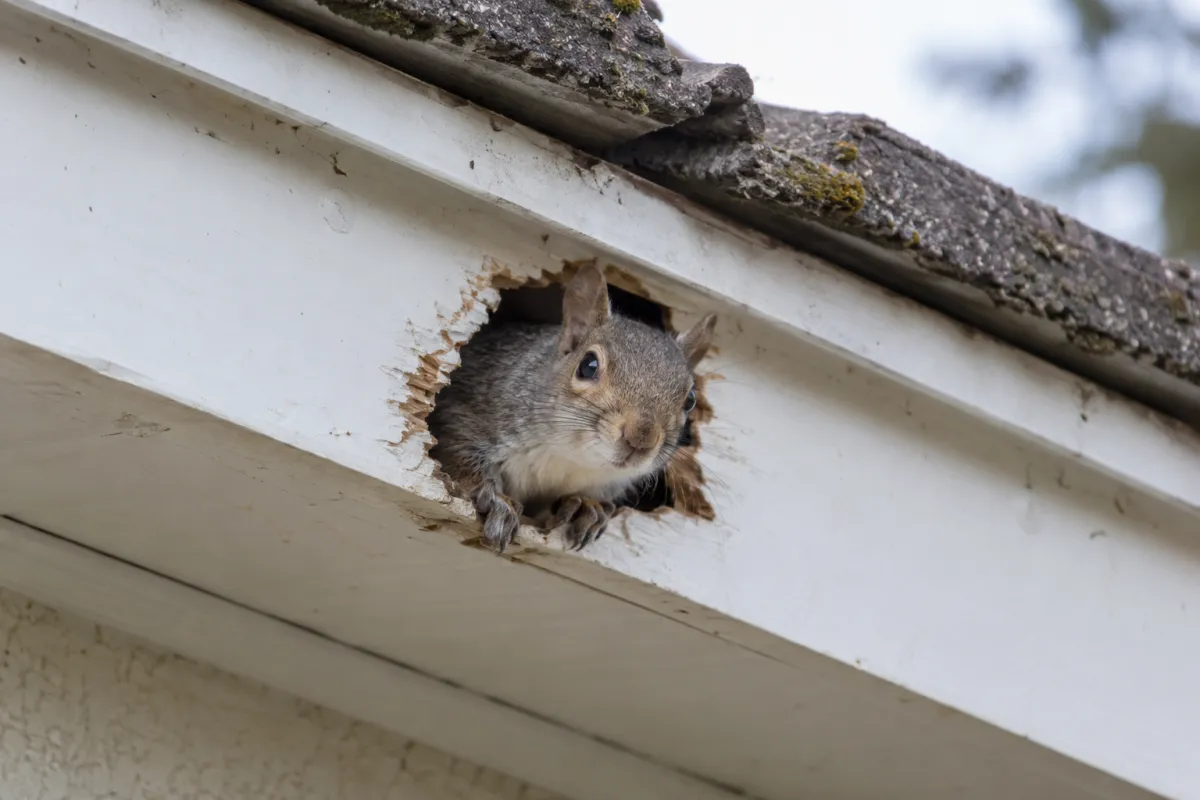
Grey squirrels are quick to find a weak point at the roofline. Once one gets into a loft, it has a warm, dry space with no predators, and it will keep coming back. Getting squirrels out is less about force and more about timing: knowing whether there are young up there, what the law allows, and when it's safe to close the way in.
Confirming it's squirrels
Noise in the early morning and late afternoon is the classic clue. A few more checks help confirm it:
- Droppings. Squirrel droppings are around 8 mm long and barrel-shaped, with rounded ends, which makes them bigger and fatter than a mouse's.
- The nest. A bulky heap of shredded insulation, leaves, twigs, paper and fabric, usually near the eaves or tucked into a corner.
- The way in. Watch the roofline for half an hour after sunrise. Squirrels leave and return through the same hole, often with fresh chew marks around the edge.
- The daily pattern. They usually head out soon after sunrise and settle back in during the late afternoon. In cold or wet weather they may stay in for most of the day.
If you also hear noise in the middle of the night, you may have rats or mice as well, or instead.
What the law says
Grey squirrels aren't protected, but several laws shape what can be done:
- It's illegal to release a grey squirrel into the wild once it's been caught.
- Grey squirrels are listed as an invasive species, which restricts keeping and moving them.
- Once a squirrel is trapped, it's under human control, and animal welfare law requires it to be treated humanely.
- Rat and mouse poisons are authorised only for use against rats and mice, so using them on squirrels is against the law.
This is why a cage trap bought online so often goes wrong. You end up with a stressed animal you can't release and must deal with humanely, straight away.
Why timing matters
Grey squirrels usually have two litters a year: one born around February to April, and a second around June to August. The young stay in the nest for about ten weeks.
- If you close the entrance while young are inside, the mother will try hard to get back in, often by chewing a new hole in the fascia or roof. The young will die in the loft, causing a smell and attracting flies.
- If you close it while an adult is inside, it will chew its way out, sometimes into the house.
Late autumn, after the summer young have left and before the winter breeding season, is often the most practical time to proof. Even then, only seal the hole once you're sure the loft is empty. Some people loosely stuff the entrance with scrunched newspaper; if it's still in place after a few dry days, the hole probably isn't in use.
What to do in the meantime
- Cover the water tank. Make sure the cold water tank in the loft has a fitted lid. A squirrel that falls into an open tank can drown and contaminate the water.
- Keep the hatch shut. Fit a catch and draught strip to the loft hatch so a squirrel can't push its way down into the house.
- Check the wiring. Squirrels chew cables as well as timber. Our guide to rodent damage to wiring, pipes and insulation explains what to look for and why an electrician should check anything chewed.
- Talk to the neighbours. In terraces and semis, the hole may be on their side of a shared roofline.
- Don't rely on deterrents. A radio or a light left on in the loft may make it less comfortable, but it won't move a mother with young.
Repairs once they've gone
Squirrels chew through plastic, rotten timber and chicken wire, so repairs need to be tougher than the original. Replace damaged fascia and soffit boards, and back any gaps with heavy-gauge galvanised mesh or metal flashing. Check the rest of the roofline at the same time, because squirrels that lose one way in often test another. Our page on keeping squirrels off your roof covers the routes they use to get up there.
Then look over the loft. Bag and replace soiled insulation, wearing gloves and a dust mask, and check timbers, pipes and lagging for gnawing. The squirrel control page explains what a survey involves, and our squirrel control guide covers how to arrange a visit.
If you can hear squirrels in your loft and want them dealt with properly, call Mighty Pest Control on 020 7112 8473.