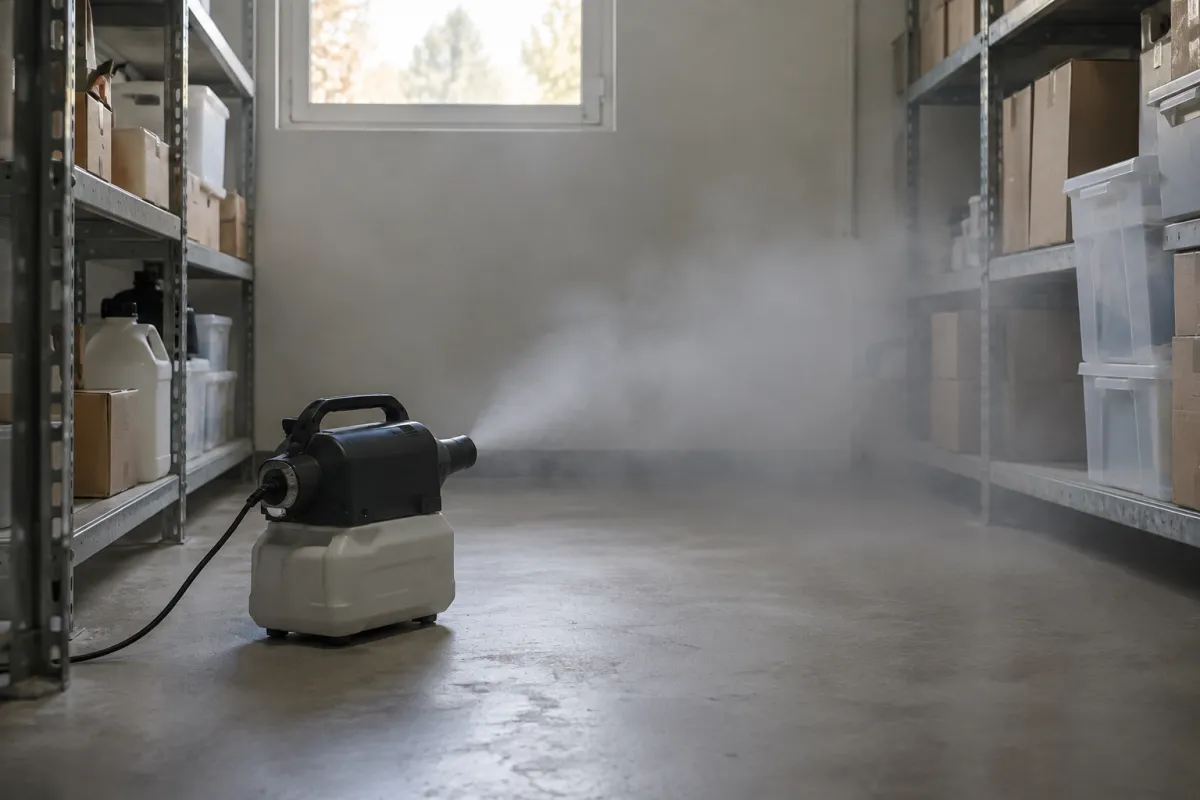
When people hear "fumigation", many picture a whole house sealed under a tent. In homes and business premises, the word usually means something smaller and more controlled: a space treatment, where an insecticide is dispersed as a fine mist or fog through a closed room, loft or storeroom so it reaches insects throughout the space.
Fumigation and space treatment
Strictly speaking, fumigation means filling a sealed space with a toxic gas. That kind of work is used on things like shipping containers and stored commodities, and it's carried out only by specially trained operators under strict controls. It isn't something a house, flat or shop normally needs.
A space treatment works differently. A machine called a fogger breaks a liquid insecticide into droplets small enough to hang in the air. The droplets drift through the closed space, settle on surfaces and act on the insects they touch. Because the mist spreads on its own, it reaches high corners, ceilings, window frames and the gaps behind furniture that a hand sprayer would struggle to cover evenly.
When a space treatment makes sense
It works best when insects are spread through a whole area rather than coming from one spot. Typical situations include:
- flies or moths throughout a room, loft or storeroom
- cluster flies gathered in a roof space in autumn
- large numbers of insects resting on walls, ceilings and windows
- a room or property that's standing empty and can be treated as a whole
- a heavy infestation, where a space treatment supports other methods
What these have in common is a space that can be cleared of people and pets, closed up and left alone for as long as the product needs.
What it can't do
A fog is good at reaching insects out in the open. It's much less good at reaching insects tucked away out of sight. It doesn't get far into:
- cracks in skirting boards and floorboards
- wall cavities and the voids behind kitchen units
- mattresses, upholstery and soft furnishings
- sealed boxes, packaging and stored goods
Eggs and pupae are also harder to kill than active insects, so new adults can turn up for a while afterwards as they hatch or emerge.
A space treatment doesn't remove whatever is drawing insects in, either. If flies are breeding in a bin, a drain or forgotten food, they'll be back unless the source goes. And it isn't the right tool for every pest. It does nothing for rats or mice, and with insects that live deep in cracks, such as bed bugs and cockroaches, fogging on its own tends to miss most of them and can push them into new hiding places.
Safety and going back in
The products used are made to kill insects, so nobody, pets included, stays in the space while it's treated or goes back in until it's safe. There's no single waiting time that fits every job. How long the space stays closed, and how long it's aired before anyone uses it again, is set by the product label and the technician's instructions for that particular space. You should know these timings before the day, so you can plan around them.
A few precautions usually come up when a treatment is planned:
- Food, dishes, toothbrushes and pet bowls are put away or taken out, so nothing is left exposed.
- Fish tanks are covered and their pumps switched off, as many insecticides are harmful to fish.
- Naked flames and pilot lights are turned off.
- Smoke and fire alarms are talked through beforehand, because fog can set them off. In a block of flats, that includes any shared system.
- Anyone with asthma or another breathing condition should say so when the treatment is being arranged.
Once you're back in, wipe down surfaces that come into contact with food before you use them.
How it fits with other treatments
A space treatment is rarely the whole answer. It's usually one part of a plan that starts with working out which insect you have and where it's coming from. Alongside it, you might see:
- targeted spraying of the cracks, crevices and surfaces where insects hide or walk
- baits for pests such as ants and cockroaches
- removing or cleaning the source, such as infested stock, waste or damp
- proofing, such as fly screens or sealing the gaps where insects get in
- monitoring and follow-up visits to catch insects that hatch later
If you're weighing up whether a fog or a targeted spray suits your problem better, our guide to fogging or spraying compares the two. For warehouses, shops and food storage, where stock and opening hours shape the plan, see fumigation for businesses. To find out what happens on the day of a treatment, see our fumigation services page.