Fogging or spraying: which treatment fits
Fogging fills a closed space, spraying targets where insects hide. How they differ, which pests suit each and how to decide.
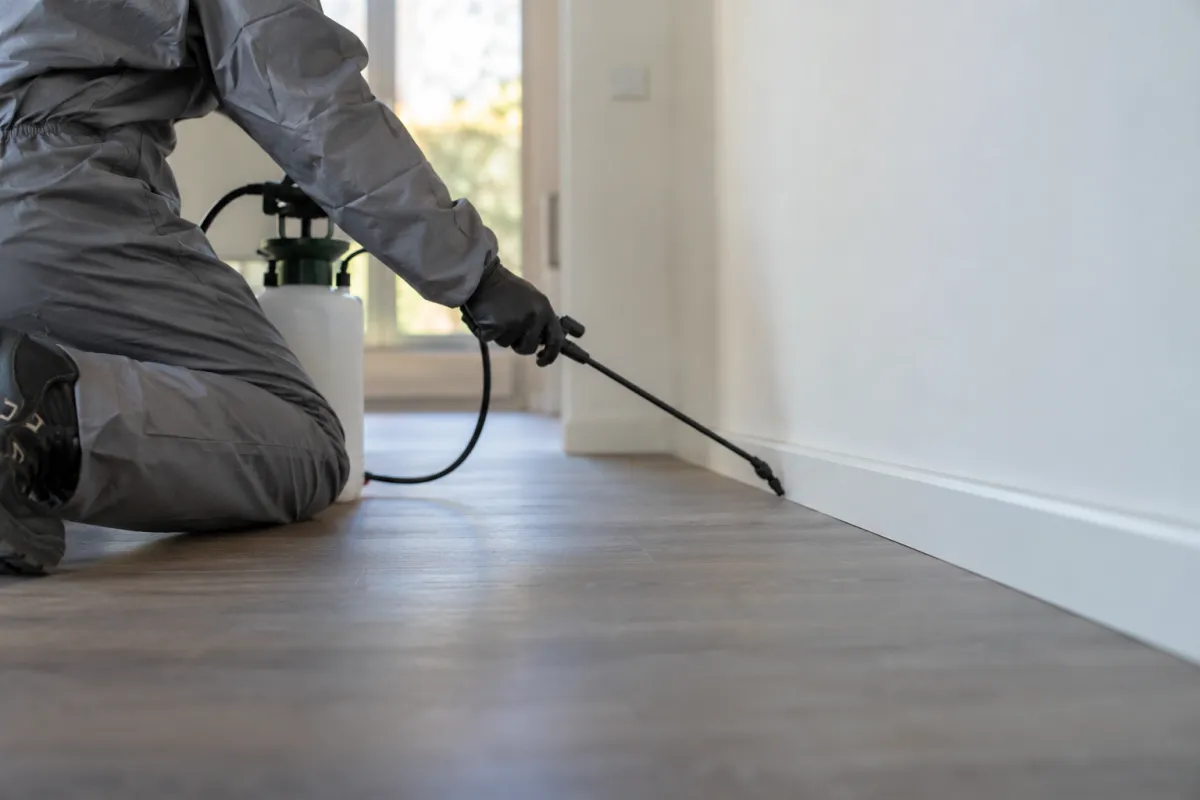
When people ask for fumigation, what they usually need is one of two quite different treatments. One is fogging, where a fine insecticide mist fills a closed space. The other is targeted spraying, where insecticide is put exactly where the insects walk and hide. Each suits different pests and different spaces, and choosing the wrong one wastes a day and leaves the problem in place. Here's how to tell which fits.
How the two methods differ
Targeted spraying puts insecticide on chosen surfaces: along skirting boards, into cracks and crevices, over carpets, around pipework and under units. It dries to a thin film that keeps working as insects walk over it. Depending on the product and the surface, that can last for weeks. Most of its work happens after the technician has gone, as insects come out of hiding and cross the treated areas.
Fogging turns liquid insecticide into droplets fine enough to hang in the air and drift through a closed room, loft or storeroom. It acts on the insects that are out in the open while the mist is in the air, and on surfaces where it settles. It covers a whole space quickly and evenly, but it does most of its work in a short window. It gets only a little way into the places insects hide.
Put simply, spraying puts the insecticide where the insects go. Fogging puts it everywhere for a short time.
Which pests suit which method
These are typical starting points. The final choice always depends on what the survey finds.
Usually suits fogging
- Cluster flies gathered in a loft, among the rafters and around the windows. Our guide to cluster flies explains why they collect there.
- Flies throughout a storeroom, bin store or outbuilding, once the source has been found.
- Moths or beetles flying or resting throughout a storeroom that can be emptied.
Usually suits targeted spraying or other targeted methods
- Fleas, where the larvae live deep in carpets, rugs and furniture.
- Bed bugs, which hide in seams, joints and cracks near the bed. Fogging tends to scatter them.
- Cockroaches, which are mainly treated with baits and crack-and-crevice treatment.
- Clothes moth larvae feeding in carpet edges and under furniture.
- Ants, which need baits that workers carry back to the nest. Neither method suits them.
Often a combination
- A heavy infestation of flying insects with breeding sites in cracks, such as a storeroom with moths in the air and larvae in the corners.
What each means for you on the day
The two treatments ask quite different things of the people using the space.
Who has to stay out
With a targeted spray, the treated rooms usually need to be kept clear until the surfaces are dry, and you're told when that is. With fogging, the whole closed space has to be empty of people and pets for the full time set by the product label and the technician, and then aired before anyone goes back in.
Getting ready
For a spray, the main job is clearing floors and pulling furniture away from walls, so every edge can be reached. For fogging, everything that could be exposed has to be packed away or covered, cupboards and drawers are left open, and alarms and naked flames are dealt with first.
Afterwards
After spraying, don't wash, mop or vacuum the treated surfaces until you're told you can. The film left behind is what keeps working. After fogging, you air the space, wipe down food-contact surfaces and wash anything that was left out.
Questions that decide it
When you're talking through a treatment, these are the questions that usually settle the choice.
- Where are the insects? Flying, or resting in the open on walls, windows and ceilings, points to fogging. Hidden in cracks, fabrics and voids points to targeted treatment.
- Can the space be closed and emptied? Fogging needs a space that can be shut off and left. A room with open vents to a neighbour, or one people can't leave, may rule it out.
- Is the breeding source known? Neither method fixes a source left in place. If flies are breeding in a drain or moths in a sack of stock, that comes first.
- Do you need protection that lasts? If new insects will keep hatching or arriving for weeks, a lasting targeted treatment matters more than a one-off knockdown.
- Who uses the space? Mention anyone with asthma or another breathing condition, babies and young children, and pets such as fish and caged birds at the start, as this can change the method and the timings.
Using both together
For bigger problems, the two methods often work in sequence. In an emptied storeroom with moths, for example, the space is cleaned first and infested stock removed. Then cracks, shelving joints and wall bases get a targeted spray for the larvae, and the space is fogged for the adults. A follow-up visit catches insects that hatch afterwards.
Our fumigation guide explains what space treatment can and can't reach, and our fumigation services page sets out how a treatment day runs. For warehouses, shops and food stores, see fumigation for businesses.
If you're not sure which treatment your problem needs, call us on 020 7112 8473.