Fumigation for warehouses, shops and food storage
Stock, alarms, ventilation, staff and reopening: what a business needs to plan for a fogging treatment, and how to stop insects coming back.
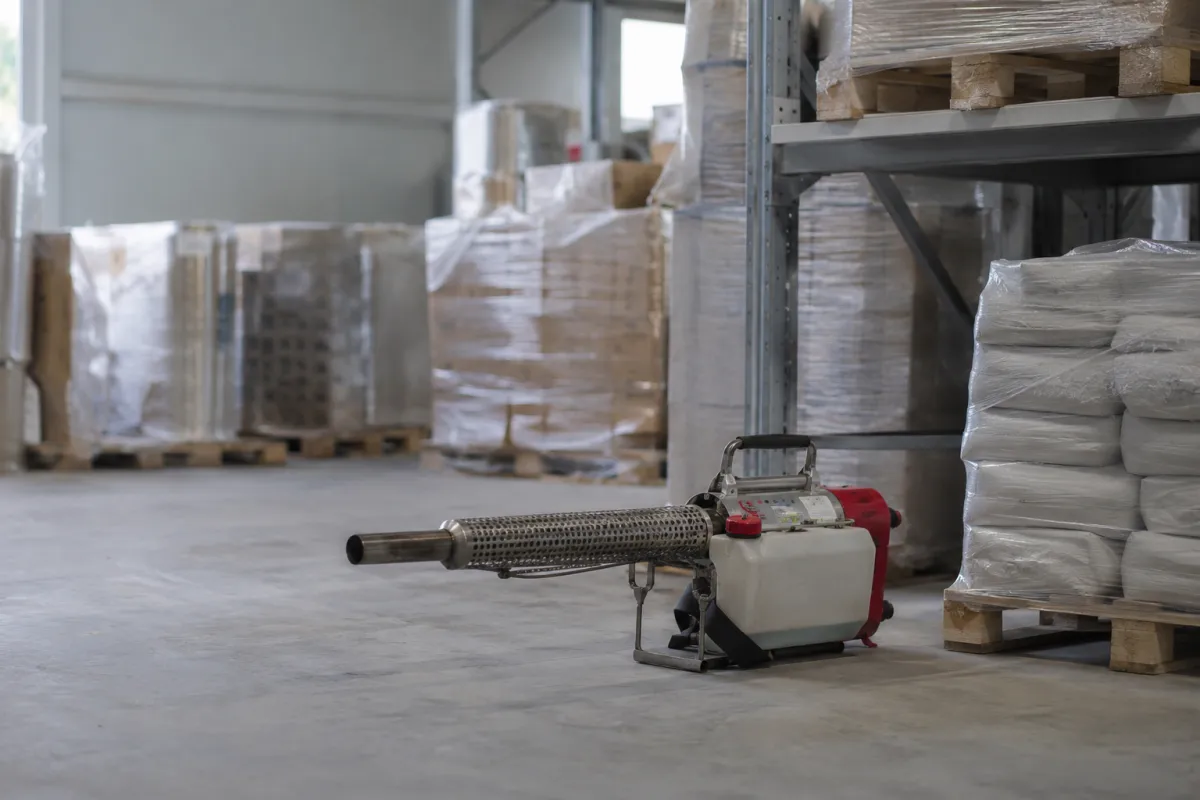
In a warehouse, shop stockroom or food store, a space treatment is as much a planning job as a pest control job. Stock has to be dealt with, alarms and ventilation managed, staff kept informed and the site reopened on time. Here's what to sort out before, during and after a treatment by fogging or misting.
When a space treatment makes sense for a business
Space treatment suits commercial premises where insects are spread through an area that can be closed off for a while. Typical examples include:
- stored product moths flying through warehouse racking or a dry goods store
- beetles and weevils spread through a storeroom of grain, flour, nuts or dried fruit
- flies throughout a stockroom, loading bay or bin store once the source is cleared
- a vacant unit that needs treating before a fit-out or a new tenant
It's less suitable where the space can't be shut down, or where the air is shared with occupied areas through an open ceiling void or common ventilation. In those cases, targeted treatments usually come first. Our guide to fogging or spraying explains the difference.
Stock, food and equipment
The mist acts on insects out in the open. It doesn't get inside sealed boxes, wrapped pallets or sacks. So any infested stock left on site will simply start the problem again.
- Find the source first. Check stock for webbing, larvae, holes in packaging and insects in the product, starting with the oldest and slowest-moving lines. Our guide to food cupboard pests shows what the common stored product insects look like.
- Remove or quarantine infested goods before the treatment, sealed so insects can't escape on the way out.
- Take out or seal exposed food, and remove or cover anything that touches food: utensils, scales, slicers, chopping boards and preparation surfaces. What can stay, and how it must be covered, depends on the product label and the technician's instructions.
- Pull pallets and stock away from walls where you can, and clear the floor under the bottom racking, so the mist reaches the edges where insects shelter.
- Move live animals and fish off site. This includes a pet shop's livestock and any aquarium.
Alarms, ventilation and the rest of the building
Commercial buildings have systems that a home doesn't, and each needs a plan.
- Fire detection. Fog can set off smoke detectors. Agree in advance, with whoever maintains your fire alarm, how detection in the treated area will be handled during the treatment and restored afterwards. If your alarm is monitored, make sure the monitoring company knows too.
- Ventilation and air handling. Air handling units, extract fans and air curtains serving the area usually need switching off, so the mist stays where it's needed and isn't carried into other parts of the building. They may then be used to help clear the space afterwards, as the technician advises.
- Shared buildings. If you share a ceiling void, ducting or a loading bay with another business, tell your landlord or managing agent and the neighbouring occupiers before the day.
- Flames and gas appliances. Pilot lights and anything with a naked flame in the area need to be off.
Planning the closure and reopening
Space treatments are usually timed for when the premises are closed, such as overnight, over a weekend or across a bank holiday. Work backwards from when you need to reopen and allow for each stage:
- preparing the area and moving stock
- the treatment itself
- the closed period set by the product label
- ventilation, until the technician says the space is safe to enter
- cleaning food-contact surfaces and restocking
There's no standard length for any of these. The technician will set the timings for your space and product, and you should have them in writing before the day.
On the day, post warning notices on every door into the area and control the keys. Make sure everyone who might come in knows to stay out, including staff, cleaners, security, contractors and drivers making early deliveries. Brief your staff on what's happening and when they can go back in. Employers must protect staff from hazardous substances at work under the Control of Substances Hazardous to Health (COSHH) Regulations 2002. So ask for the contractor's risk assessment and method statement, along with safety data sheets for the products used.
Keep the treatment report with your pest control records.
Stopping it coming back
Eggs and pupae can survive a space treatment, and new insects can arrive with the next delivery. A follow-up visit and a few routines help.
- Rotate stock so older goods are used or checked first, and don't let slow-moving lines sit for months.
- Check deliveries on arrival, and reject or isolate anything showing insects or damage.
- Clean up spillages in racking, under pallets and in corners, where stored product insects breed unnoticed.
- Monitor. Pheromone traps for stored product moths and regular checks by staff show early whether insects are returning.
- Proof the building. Close-fitting doors and screens on opening windows help keep flying insects out.
Our fumigation guide explains what space treatment can and can't reach, and our fumigation services page covers how a treatment day runs.
To talk through a treatment for your premises, call us on 020 7112 8473.