Pigeons on balconies
Why pigeons settle on balconies, how to move them on early, how netting compares with spikes, and what to do when there's already a nest.
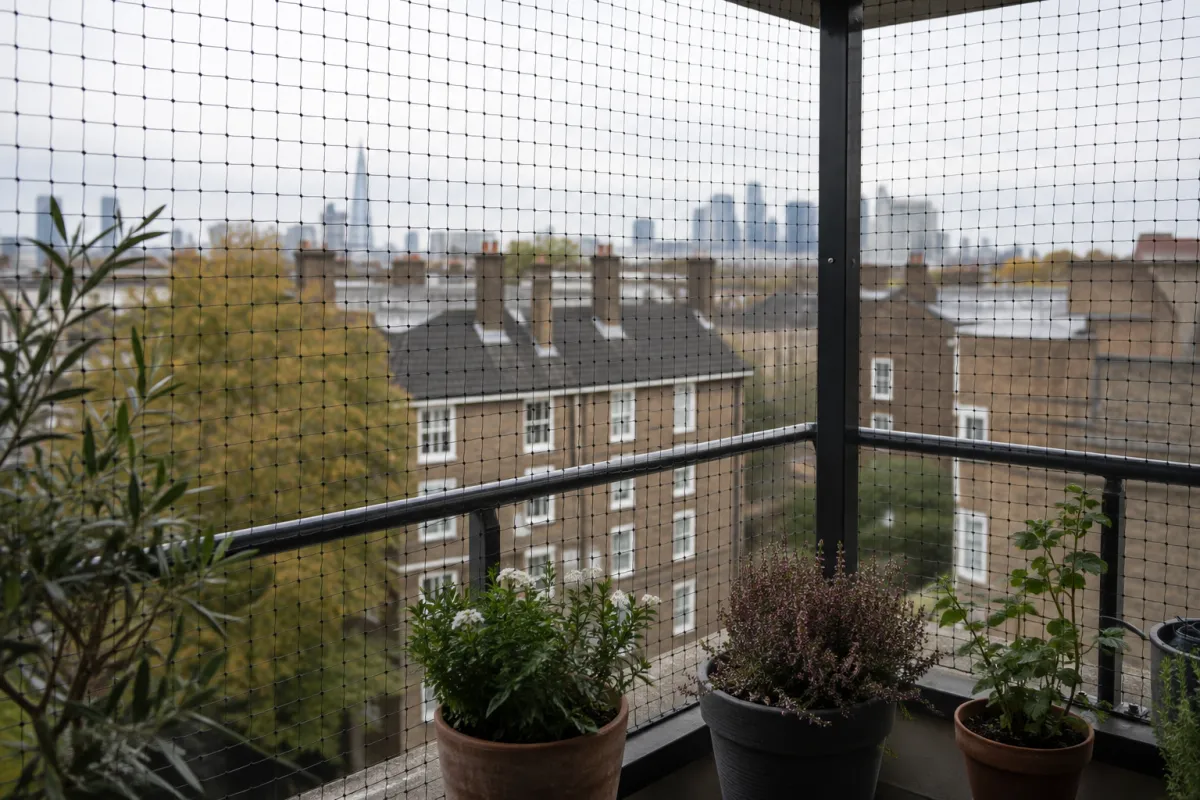
A balcony suits a pigeon very well. It's high up, sheltered from wind and rain by the balcony above, out of reach of predators and close to food on the street below. Pigeons that start by perching on the railing soon move on to resting in a corner, and then to nesting behind plant pots, stored boxes or an air conditioning unit. Once a pair has nested, droppings build up quickly and the birds return to the same spot again and again.
Why pigeons choose your balcony
- Shelter. The balcony above acts as a roof, and solid side walls keep off the wind.
- Places to hide a nest. Plant pots, bike covers, boxes and the gap behind a condenser unit all give a pigeon a corner to build in.
- Food and water. Seed put out for small birds, crumbs, pet bowls and water left in plant saucers all help.
- Peace and quiet. Balconies that are rarely used, such as one used only for storage or belonging to an empty flat, are settled first.
Act before they nest
Pigeons are far easier to move on before they've nested, and they tend to return to places they've used before, so act as soon as they start perching:
- Clear the clutter, or keep what you store in closed boxes.
- Take away food, water and plant saucers.
- Clean up droppings promptly, before the spot becomes an established roost.
- Use the balcony. Regular comings and goings disturb pigeons more than any ornament.
Plastic owls, reflective discs and windmills usually work for a few days at most.
Netting and other proofing
- Netting is the only option that keeps pigeons off a balcony completely. Pigeon netting has a 50 mm mesh and is fixed to tensioned wires around the opening, usually in black, which is the least visible from a distance. A well-fitted net has an access panel for cleaning windows, and it's checked to make sure no birds are trapped behind it.
- Spikes or sprung wires along the top of the railing stop birds perching there, but they won't stop them landing on the floor.
- Sticky repellent gels can trap and harm smaller birds, so they're best avoided.
If you rent, or own a leasehold flat, check your tenancy or lease before fixing anything to the balcony. Many freeholders and managing agents need to approve changes to the outside of a block, and some have rules about what can be fixed to balconies, including for fire safety. Where several balconies in a block are affected, it's worth asking the managing agent about proofing the whole elevation, which works better than tackling one flat at a time.
If there's already a nest
All wild birds, including feral pigeons, are protected while nesting, so a nest with eggs or chicks must be left alone. Pigeons sit on their eggs for around 18 days and the young leave at four to six weeks, so a nest is usually in use for about two months.
As soon as the young have flown and the nest is empty, act quickly:
- Remove the nest and any old nesting material.
- Clean the balcony thoroughly.
- Fit your proofing straight away, as the same pair will often start again on the same spot almost at once.
To clean, wear gloves and a disposable mask, rated FFP3 for a heavy build-up. Dampen droppings with water or disinfectant before scraping them up, bag the waste and wash your hands afterwards. Avoid pressure washers, which spray dirty water onto the balconies below and into the air.
When a nest is removed, bird mites living in it can wander indoors looking for a new host. If you notice tiny moving specks around balcony doors and windows, see our mites control page.
When to get help
It's worth getting advice if pigeons are already nesting, droppings are building up faster than you can clean them, or netting needs fixing at height. The bird control page explains what a survey involves, and our pigeon control guide covers how to arrange a visit.
If pigeons have taken over your balcony, call Mighty Pest Control on 020 7112 8473.