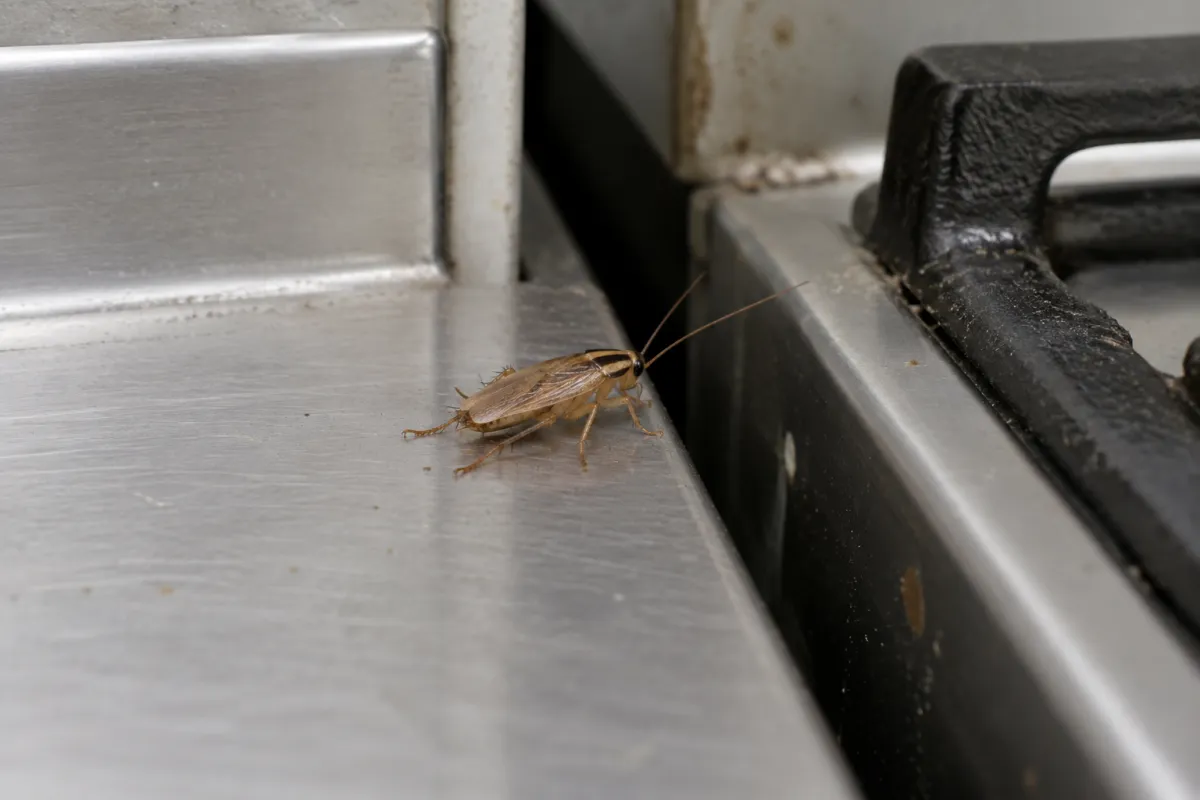
Cockroaches have six legs, wings and antennae. They can run at up to three miles an hour, and they have been around since the dinosaurs. They vary in size and colour, and their shed skin contains allergens that can cause asthma.
Common types of cockroach
Below, we focus on three of the most common cockroaches:
- the German cockroach
- the American cockroach
- the brown-banded cockroach
If you're not sure which cockroach you have, our guide to German and Oriental cockroaches can help you tell them apart.
German cockroach (Blattella germanica)
German cockroaches are the most common cockroach found in the United States. The German cockroach:
- is 12 to 17 mm long
- is tan to light brown
- has two dark brown stripes on the body region just behind the head (the pronotal shield)
Females produce four to eight egg capsules during their lifetime, and each capsule contains around 40 eggs. The female keeps the egg capsule until the eggs are ready to hatch, usually in 28 to 30 days.
German cockroaches are widespread and can be found in many indoor environments. Within these, they prefer sites close to moisture and food, which makes them common pests in:
- kitchens
- bathrooms
- food storage areas
American cockroach (Periplaneta americana)
The American cockroach is one of the largest cockroaches in the north-eastern United States.
- It is about 40 mm long, with a reddish-brown body.
- The centre of the pronotal shield is light brown, while the outer edges are yellow.
The female doesn't keep the egg capsule for more than a day after it forms. Instead, she drops it in a suitable site, and under some conditions it may be glued to a surface. A female produces 6 to 14 capsules, each containing 14 to 16 eggs. The eggs hatch in 50 to 55 days.
The American cockroach prefers dark, moist sites, where it feeds on decaying organic matter. These include:
- basements
- kitchens
- laundry baskets
- drains
- bathroom plumbing or sewers
Brown-banded cockroach (Supella longipalpa)
The brown-banded cockroach:
- is 12 mm long
- is light brown
- has two lighter-coloured bands running across the body
These bands are at the base of the wings and on the abdomen. They are much darker in the immature stages.
The female carries the egg capsule for 24 to 48 hours before gluing it to a surface. The capsule contains around 18 eggs, which hatch in 50 to 74 days. An adult female produces about 18 egg capsules over a lifespan of 10 months.
The brown-banded cockroach needs less moisture than other cockroaches. It is more common in homes, flats, hotels and hospital rooms than in restaurants or shops. Signs of this cockroach may be found:
- behind pictures
- in furniture
- on the underside of chairs and tables
- in upper kitchen cupboards
- on the upper shelves of cupboards and pantries
- in bathroom plumbing or sewers
Why control cockroaches
When cockroaches forage for food and water, they can contaminate food, utensils and preparation surfaces as they go. They taint food with an unpleasant smell and can be vectors of disease, carrying the organisms that cause food poisoning in humans, as well as many other bacteria.
Cockroaches and your business
Cockroaches can ruin an organisation's reputation. If clients and customers spot evidence of cockroaches in premises you manage, they are likely to complain, ask for a refund and report negatively on your company. An infestation can potentially result in closure by an Environmental Health Officer, and some people may be unlikely to want to do business with you again.
How to prevent cockroaches
Areas with food, water and dark spaces to hide in are ideal places for cockroaches to live. Here are a few prevention tips for securing your property.
Keep areas clean and tidy
- Clean all surfaces thoroughly to remove any food residue.
- Don't let dirty dishes and utensils build up in the sink or stay there overnight.
- Check the critical area between the cooker and the cupboards, where grease and food scraps often build up.
- Keep food scraps in the fridge or in containers with tight-fitting lids.
- Keep bins covered and clean, and empty them regularly.
- Areas such as the top of and beneath your fridge are warm, and food collects there, attracting cockroaches, so clean these areas regularly.
Proofing and repair
- Seal gaps around doors and windows, and where utility pipes and cables come in, to stop cockroaches getting in.
- If possible, repair any leaks beneath the sink and on the sink top straight away, cutting off a potential water source.
How to get rid of cockroaches
Control of cockroaches is seldom easy, because it's difficult to get the insecticide to the insect. Ideally, the insecticide should last long enough to kill the nymphs that hatch later from unhatched egg capsules.
For any cockroach infestation, we would always recommend contacting a professional pest control company, such as our cockroach control service. Professionals are trained in cockroach control and have access to a range of professional-use insecticides that are not available to the public.
Before you do anything, please consider the following steps:
- Hygiene: thoroughly clean the area before any insecticide treatment. Pay particular attention to removing food and water sources and hiding places.
- Sticky traps: these are not recommended for controlling cockroaches and should be used for monitoring only.
- Insecticide treatment: success depends on which insecticides are chosen and how thoroughly they are applied. Pay particular attention to cracks and crevices where eggs and nymphs may be found.