Wasp or bee? How to tell and why it matters
How to tell wasps from bees and hornets by their looks and their nests, and why the answer changes what you should do next.
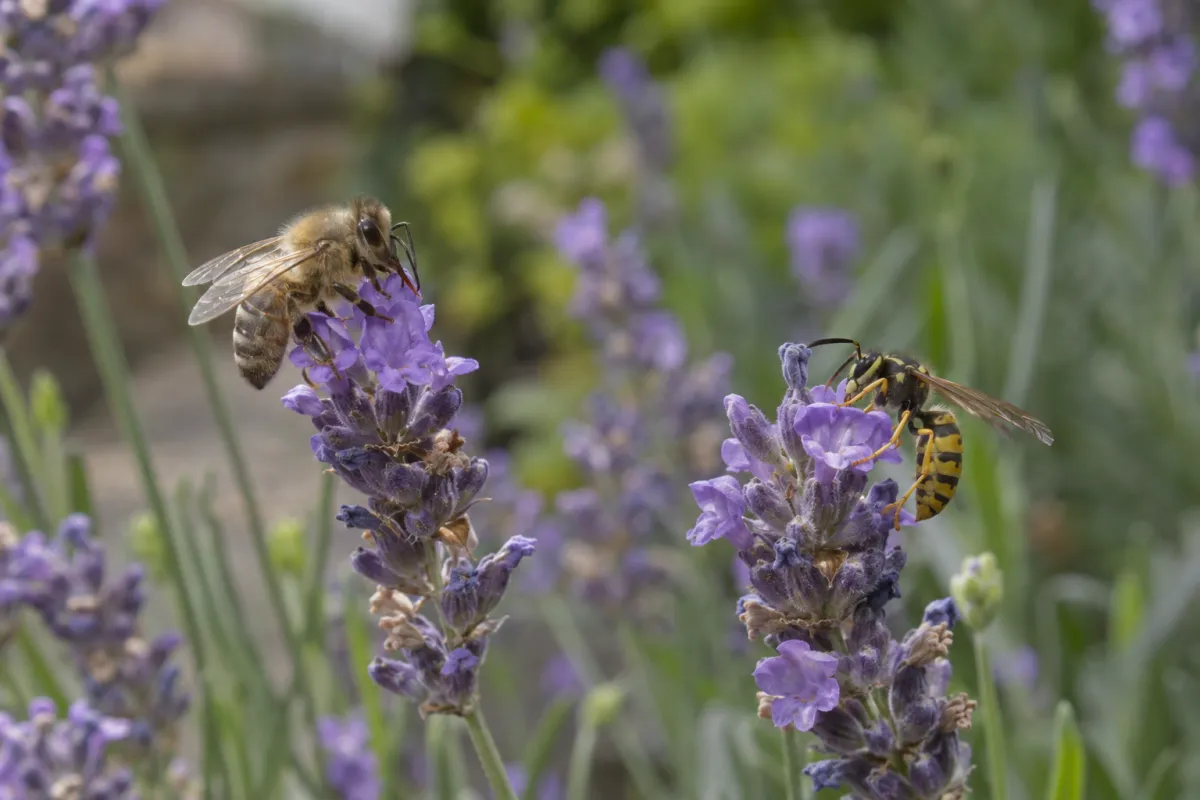
In spring and summer, anything buzzing in and out of a gap in the eaves tends to get called a wasp. Quite often it's a bee. The difference matters. Wasp nests can be treated, but bees are important pollinators, most bee nests are harmless if left alone, and treating a honeybee colony with insecticide can end up poisoning other bees. A few minutes watching from a safe distance usually tells you which you have.
Telling them apart
- Wasps. The common wasp and German wasp are around 12–20 mm long, smooth and shiny, with bright yellow and black bands and a narrow waist. They don't carry pollen. You'll see them scraping wood from fences, scavenging around bins and drinks, or flying straight in and out of a nest entrance.
- Honeybees. Around 12–15 mm long, slimmer than a bumblebee, mostly golden-brown with darker bands and a light covering of hair. They often carry pollen as yellow or orange lumps on their back legs.
- Bumblebees. Round, furry and slower-moving, with bands of yellow, black, white or ginger, and often a pollen load on their back legs.
- Solitary bees. Many different species, from small dark mining bees to gingery mason bees. Each female nests on her own, although lots may nest close together.
- Hornets. The European hornet is a native species and much bigger than a wasp, with a queen reaching around 3.5 cm. It's chestnut-brown and yellow rather than black and yellow, and it often flies at night towards lit windows. An almost black hornet with a single orange band near the tail and yellow legs may be an Asian hornet, which should be reported.
What the nest tells you
- Wasp nest. A grey or buff papery ball with a swirled surface and a single entrance, in a loft, under the eaves, in a wall cavity, a shed or a hole in the ground. It grows from golf-ball size in spring to football size or bigger by late summer.
- Honeybee colony. Sheets of pale yellow wax comb, usually hidden inside a wall, chimney or roof space, with a busy stream of bees at a small gap. From about May to July you may also see a swarm: a large cluster of bees hanging from a branch, fence or wall, which usually moves on within a few hours to a couple of days.
- Bumblebee nest. Small and untidy, often in a bird box, compost heap, under a shed or decking, or in loft insulation. A colony is usually anything from a few dozen to a few hundred bees.
- Tree bumblebee nest. Very common in London. Tree bumblebees have a ginger thorax, black body and white tail, and they nest high up in bird boxes, eaves and soffits. In early summer you'll see males hovering around the entrance. Colonies usually finish by mid to late summer.
- Solitary bee nests. Small holes in soft mortar (masonry bees) or little volcano-shaped mounds of soil in lawns (mining bees), mostly in spring. Each hole belongs to one bee.
What to do about each
- Wasps. A nest in a quiet spot can be left to die off in autumn. One by a door, in a loft or near where children play is usually treated.
- A honeybee swarm. Contact a local beekeeper. The British Beekeepers Association website lists volunteer swarm collectors by area. Don't spray a swarm.
- Honeybees in a wall or chimney. An established colony is harder to deal with. Removing the comb often means opening up the structure, which is a job for an experienced beekeeper working with a builder. If insecticide is used as a last resort, the entrance must be sealed afterwards so bees from other colonies can't rob the contaminated honey and carry it back to their hives.
- Bumblebees. Leave them if you can. Nests last a few months and aren't reused. Keep people and pets away from the entrance and don't block it. If a nest really can't stay, ask a beekeeper or specialist about moving it.
- Solitary bees. They're harmless and usually gone by early summer. Masonry bees can slowly enlarge holes in soft, crumbling mortar, so repointing once they've finished for the year stops them using it again.
Honeybees and bumblebees rarely sting unless they're handled or their nest is disturbed, and a honeybee usually dies after stinging.
If you're still not sure
Take a photo or short video from a safe distance, zoomed in on the entrance, and note where the nest is and roughly how many insects are going in and out. That's usually enough for someone to identify them before any treatment is planned. Don't poke at the entrance or try to look inside.
If someone does get stung, our page on wasp stings explains what to do. The wasp control page covers how nests are treated, and our guide to wasps explains how a nest grows through the year.
If you've found a nest and want help working out what's living in it, call Mighty Pest Control on 020 7112 8473.