Wasp nests: when to leave them and when to call a professional
Not every wasp nest needs treating. How nests develop through the year, when one is safe to leave, and when to call a professional.
Wasps do useful work in the garden for much of the year, feeding on caterpillars and other insects, and a nest in a quiet corner isn't always a problem. A nest by the front door, in the loft or next to where children play is a different matter, and in late summer wasps become far more persistent around food and drink. Knowing how a nest develops makes it easier to decide what to do.
How a wasp nest develops through the year
The wasps that most often nest around UK homes are the common wasp and the German wasp. Their nests follow a yearly cycle:
- Spring. A queen that has hibernated through the winter finds a sheltered spot and starts a small nest on her own, often no bigger than a golf ball.
- Early summer. The first workers hatch and take over building the nest and feeding the young. The nest grows quickly.
- Late summer. A large nest can hold several thousand wasps and reach the size of a football or bigger. The colony starts raising new queens and males.
- Autumn. New queens leave to mate and find somewhere to hibernate. The old queen and the workers die off as the weather turns colder, and the nest is abandoned.
Nests are not reused the following year. An old, empty nest in a loft can be left where it is, or removed once you are sure it's no longer active.
Late summer is when most people notice wasps. As the colony stops raising young, the workers go looking for sugary food, which is why they gather around bins, fallen fruit and drinks in August and September.
Finding and recognising a nest
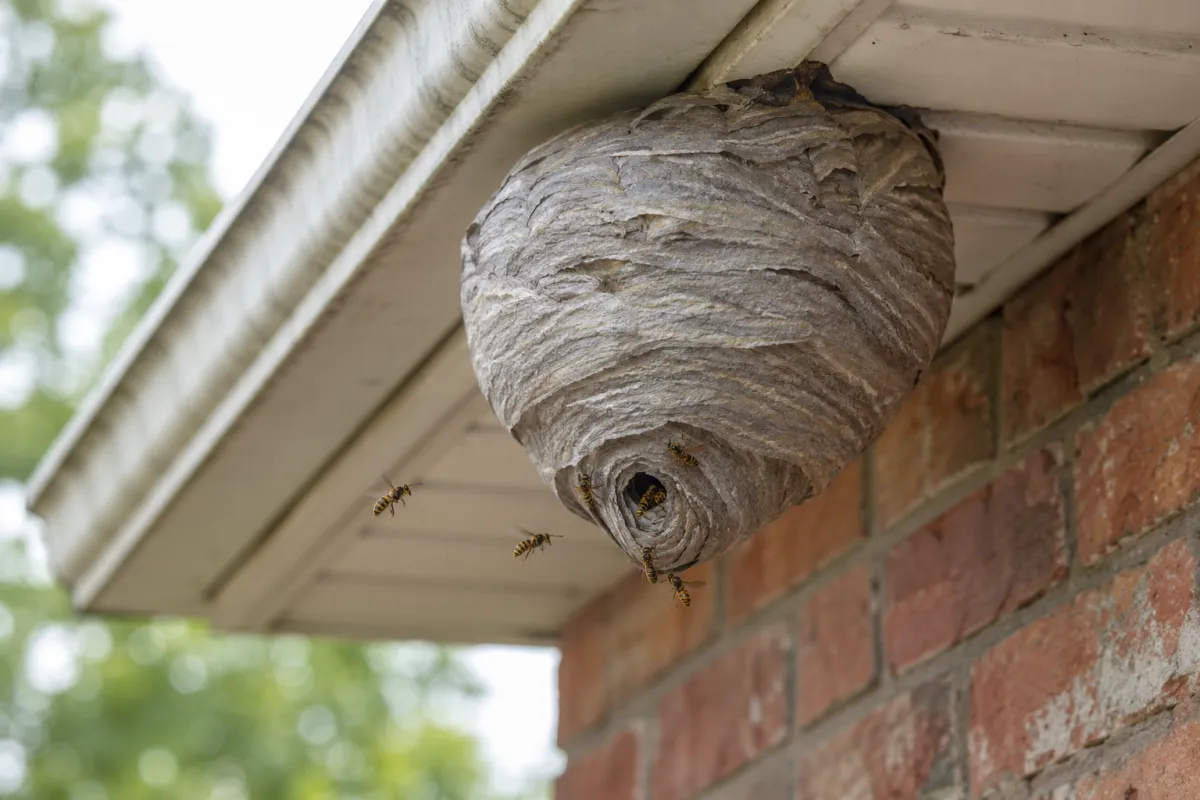
Wasp nests are made from chewed wood fibre, which gives them a grey or buff, papery look with a swirled, shell-like surface. Common sites include:
- lofts and roof spaces, often reached through gaps at the eaves or under roof tiles
- under eaves, soffits and fascia boards
- wall cavities, entered through air bricks or gaps in the mortar
- sheds, garages and summer houses
- hedges, dense shrubs and compost heaps
- holes in the ground, such as old rodent burrows
Often you won't see the nest itself, only a steady line of wasps flying in and out of the same gap. If you see that, there is very likely a nest behind it.
Bees can nest in some of the same places, so take a careful look from a safe distance. Wasps are smooth, with bright yellow and black markings and a narrow waist. Bumblebees are rounder and furry, and honeybees are smaller, browner and slightly hairy. Bumblebee nests are usually best left alone, and a local beekeeping association may be able to help with a honeybee swarm. If you think you've seen an Asian hornet, which is mostly dark with yellow-tipped legs, report it through the Asian Hornet Watch app.
When a nest can usually be left
You may decide to leave a nest alone if:
- it's well away from doors, windows, paths, bins and seating areas
- no one in the household has a known allergy to stings
- it's late in the season and activity is already dropping, so the colony will soon die off naturally
- you can keep people and pets away from it until then
Wasps are most likely to sting when they feel the nest is under threat, so avoid mowing, strimming or hedge-cutting close to it.
When to call a professional
It's time to get help if:
- the nest is near an entrance, window, path, bin store or garden seating
- anyone in the home is allergic to stings or has had a strong reaction before
- wasps are getting inside, for example through a loft hatch, a ceiling light fitting or a gap in the wall
- the nest is in a wall cavity, loft or other enclosed space you can't reach safely
- young children or pets use the area
- the nest is at a business, school or rented property where other people could be stung
What not to do:
- Don't block the entrance. Trapped wasps may chew their way out, sometimes into the house through a ceiling or wall.
- Don't hit, knock down, flood or burn a nest. Disturbing it can bring large numbers of wasps out at once.
- Don't treat a nest from a ladder. Being stung while working at height can easily lead to a fall. If you use a shop-bought product on a nest you can reach safely from the ground, follow the label and keep children and pets well away.
If someone who has been stung has difficulty breathing, swelling of the face, lips or throat, or feels faint, call 999. These can be signs of a severe allergic reaction (anaphylaxis).
Professional treatment usually involves applying an insecticide at the nest entrance. Wasps returning to the nest carry it inside, activity dies down as the colony is affected, and the nest itself normally doesn't need to be removed afterwards. You can read more on our wasp nest removal page.
If you've found a nest you're not comfortable leaving, call Mighty Pest Control on 020 7112 8473 or send us the details through our contact page.