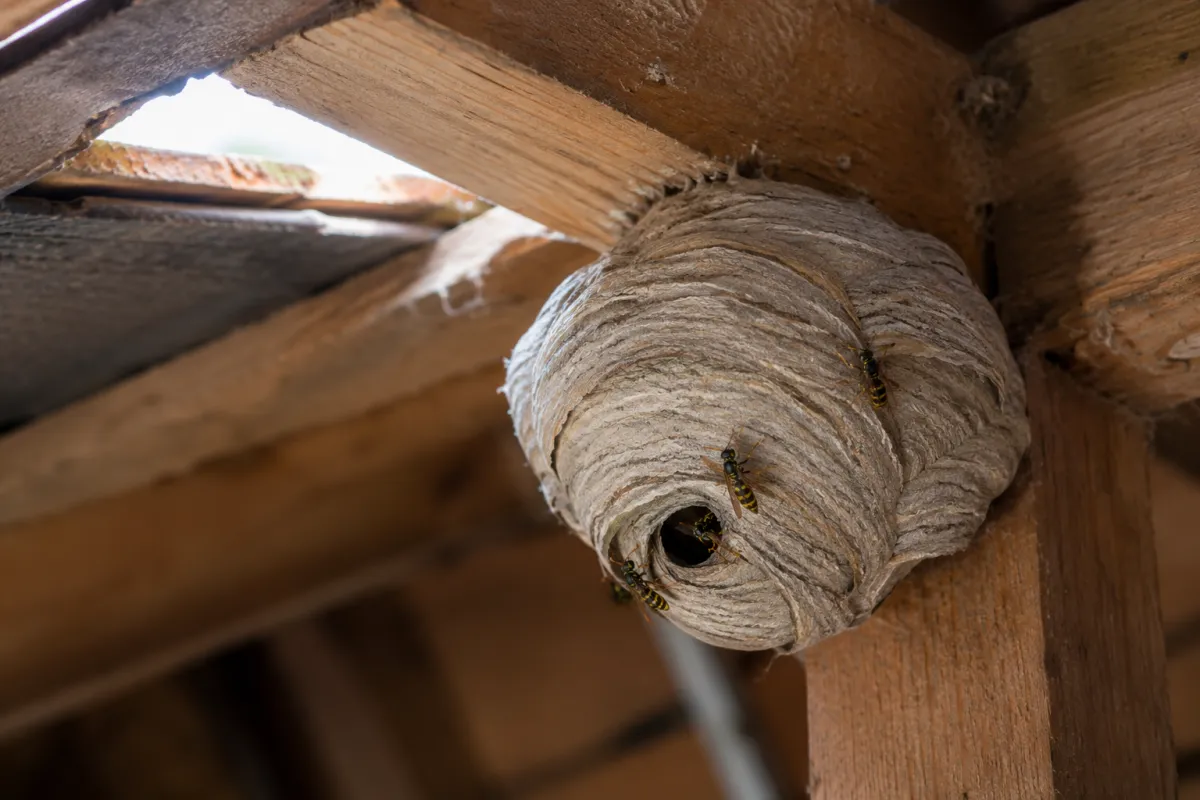
The common wasp (Vespula vulgaris) is about 15 mm long, with distinctive yellow and black banding.
How a wasp nest grows
- Spring. The queen wasp, somewhat larger than the workers, emerges from hibernation and begins to build a ball-shaped nest about 2–3 inches across. The nest is made from chewed wood pulp, laid down with a very fragile, paper-like outer shell.
- Summer. The few cells in the original golf-ball-sized nest are expanded throughout the summer. The queen keeps laying eggs, and the adult worker wasps that emerge take over the nest building to house the growing colony.
- End of summer. By now the nest may be the size of a football or larger, and will contain many thousands of developing grubs and mature wasps.
- Autumn and winter. As cold weather approaches, the colony dies off and the new queens look for a suitable sheltered spot to hibernate until the following spring, when the whole process begins again.
Where wasp nests are found
Wasp nests are often found in roof spaces, cavity walls, and holes in trees or in the ground. If you're not sure whether a nest belongs to wasps, our guide to telling wasps from bees can help.
When wasps become a nuisance
Wasps are usually only a nuisance in late summer. By then the workers have finished their nest building and become preoccupied with foraging for sweet things such as over-ripe fruit. If provoked, they are more likely to sting at that time.
Wasp nest treatment
Mighty's wasp control service is generally available when wasps are most active, from June until the end of October. You can read more on our wasp removal service page.
- The treatment consists of applying an insecticide to the nest, either as a liquid or a dust.
- The nest will then slowly die over a period of 2 to 4 days.
- Most nests are found in the roof space, but the treatment can usually be carried out without entering the loft and without unduly disturbing the wasps.
- Wasps don't reuse old nests, so there's no need to remove a dead nest.
Treating a wasp nest yourself
- This is not advised, as it can be dangerous, especially for anyone allergic to wasp stings.
- Nests can be high up or difficult to reach, so there is a risk of falling and injury.
- We recommend seeking professional advice and treatment.