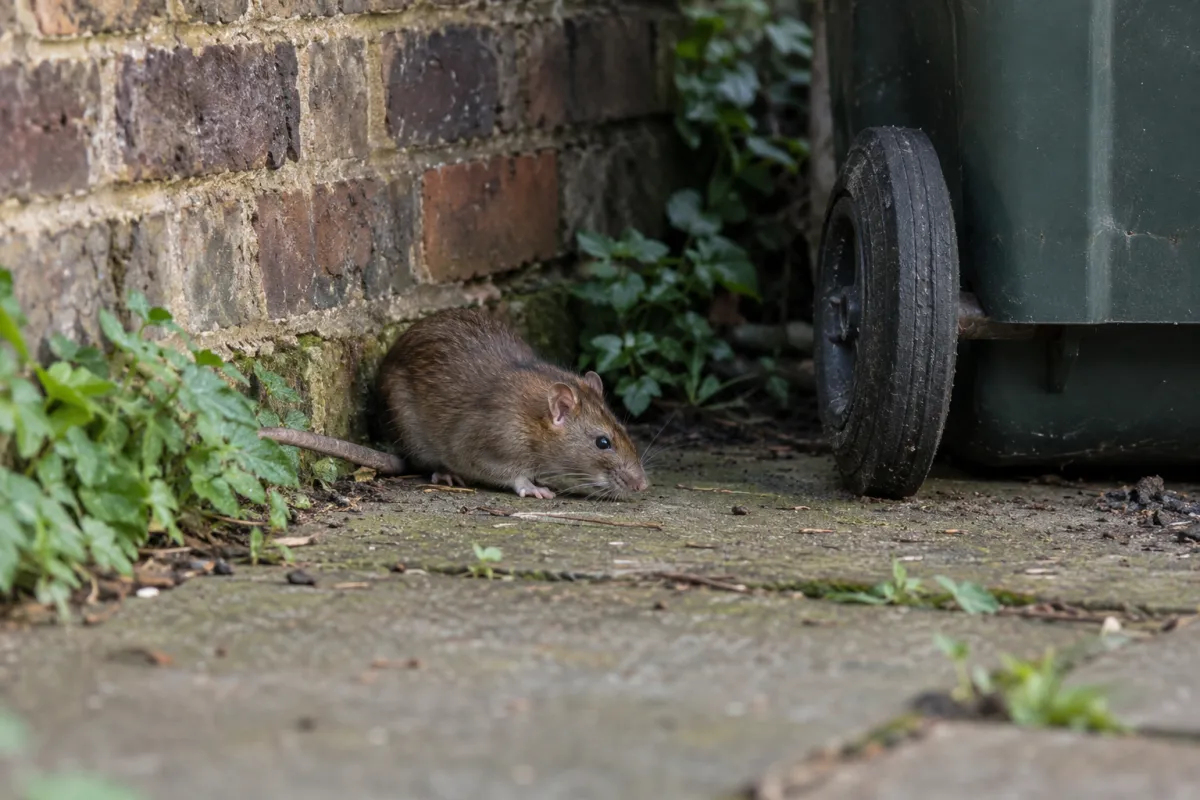
There are two different species of rat in the British Isles: the brown rat and the black rat.
The brown rat
The common or brown rat (Rattus norvegicus) is the one you are most likely to find. It lives in sewers, around watercourses, on wasteland, and in and around buildings.
- Size. A fully grown brown rat weighs around 350 g on average and has a body length of about 20 cm, with a tail that is slightly shorter than its body.
- Appearance. Its fur is coarse and varies in colour from grey-brown to almost black, with a paler underside. To complete the picture, it has a blunt snout and small, furry ears.
- Behaviour. The brown rat is an agile climber and may nest in roofs or the upper floors of buildings. It is mainly active at night, but may be seen foraging for food and water during the day, particularly where there is a heavy infestation.
- Droppings. Brown rat droppings are spindle-shaped.
The black rat
The ship or black rat (Rattus rattus) is far less common and is now very rare in Britain. It has usually been found around docks, but it can also infest warehouses and other buildings. Although it is rarely seen, it has been in Britain far longer than the brown rat.
- Size. The black rat is considerably smaller than the brown rat, reaching only around 300 g in weight. Unlike the brown rat, it has a thin tail that is longer than its 17–20 cm head and body.
- Appearance. It has black or dark brown fur with an almost white underside, a pointed snout and large, translucent ears.
- Behaviour. Much like the brown rat, it is an agile climber.
- Droppings. Black rat droppings are banana- or sausage-shaped.
It is extremely unlikely that you will come across a black rat in East London nowadays.
What rats need
All rats need a constant supply of food and water to survive and breed, along with shelter and a safe place to build a nest. The best means of control is therefore to make sure these are not available.
Proper disposal of rubbish is essential to prevent a rat infestation, as is proper storage of food. For example, grain and seeds stored loosely in sheds are an ideal source of food for rats.
What you can do to prevent rat infestations
- Keep your property clean and tidy, and cut back any overgrown areas of your land.
- Make sure your property is in good repair, your external doors are close-fitting, and there are no broken air vents or other openings in external walls for rats to get in through.
- Don't allow household or business waste to build up outside your property.
- Don't leave bread, food waste or wild bird food out overnight, as it will attract rats.
- Clear up any food you have left out for birds that hasn't been eaten by the end of the day.
- Replace any broken manhole covers and, where they are your responsibility, repair any damaged or open drains on your property. Our guide to rats in drains explains how rats use them to get into homes.
- When carrying out any work to the drains that serve your property, or if you are adding a new structure to the existing building, make sure your builder has properly sealed any redundant drains and backfilled any unnecessary voids below ground that might give rats harbourage.
Why control rats?
- Health. Rats pose a significant health risk. They carry a range of serious diseases that can be passed to humans, often through their urine and droppings, including leptospirosis (Weil's disease), salmonella, listeria, toxoplasmosis (Toxoplasma gondii) and hantavirus. The most serious of these are Weil's disease, salmonella food poisoning and toxoplasmosis. In the past, rats also spread plague.
- Contaminated food. Rats infest food and contaminate it with their urine and droppings.
- Damage to buildings. Rats can cause a great deal of structural damage by gnawing through timbers, pipes, cables and other building materials. They can cause serious fires by gnawing away the insulation around electrical cables, floods by puncturing pipes, and even death by chewing through gas pipes. The insurance sector has estimated that rodent damage to wiring is responsible for 25% of all electrical fires in buildings.
- Reputation. Rats can ruin an organisation's reputation. If clients and customers spot evidence of a rodent infestation in the premises you manage, they are unlikely to want to do business with you.
- The law. Property owners and occupiers have legal responsibilities under the Prevention of Damage by Pests Act 1949. Occupiers must report rats or mice living on their land in substantial numbers to the local authority, and the council can require owners and occupiers to clear an infestation.
How to get rid of rats
Rats are adaptable, highly mobile and breed rapidly, and this combination can make rat control a difficult task for the untrained individual.
For any rat infestation, we would always recommend contacting a professional pest control company. Professionals are trained in rat control and have access to a range of professional-use rodenticides that are not available to the public. Our rat control service explains what a treatment involves.
Safety information
The poison baits used by Mighty Pest Control are the safest available and do not pose a risk to people unless taken deliberately.
- Baits are only laid in areas where it is safe to do so.
- Baits are never laid in places open to the general public, unless in a secure container.
- If you use the service, you will also be given an information sheet on the rodenticide used by the pest controller, with further information.