Mice in walls, lofts and under floors
Mice live in the hidden spaces of a house. How those voids connect, how to work out where the mice are, and how to trap them and seal up afterwards.
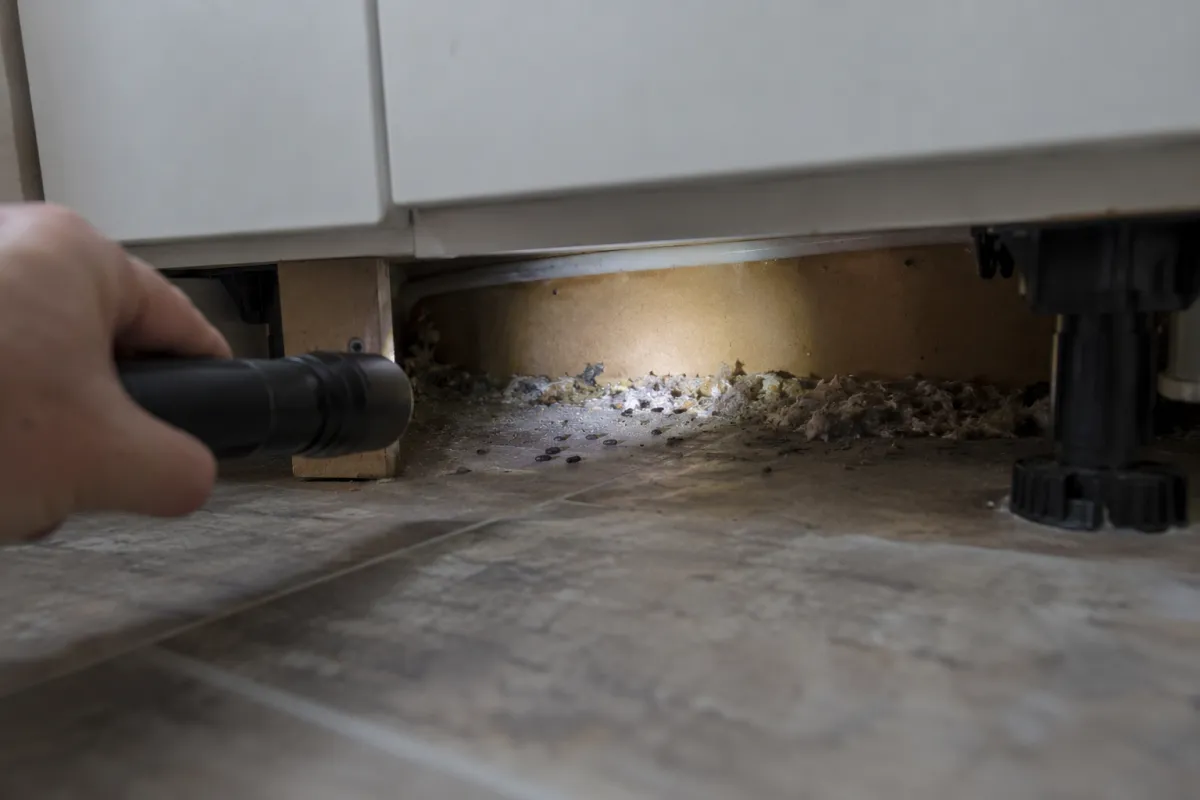
Scratching inside a wall or above the ceiling is an unsettling way to find out you have mice: you can hear them, but you can't see them. Mice spend most of their time in the hidden spaces of a building and only come out to feed, so knowing how those spaces join up tells you where to look, where to set traps and which gaps to close.
How the hidden spaces in a house connect
Mice treat the empty spaces inside a home as one network.
- Under the ground floor. Many Victorian and Edwardian terraces have suspended timber floors with a shallow void underneath. Mice run along the joists and come up wherever a pipe or cable passes through the floorboards.
- Between floors. Joists, pipes and cables cross the gap between a ceiling and the floor above. In flats, scratching overhead is often in the void below your neighbour's floor.
- Inside walls. Stud partitions, cavity walls and dry-lined walls all have hollow space inside. An old solid brick wall doesn't, so noise "in the wall" of an older house is often in boxing, a chimney breast or dry-lining.
- Behind kitchen units. There's a void under every unit behind the plinth, and a gap behind the units where the pipes run. It often links to the floor void through the hole cut for the sink waste.
- Boxing and risers. Boxed-in pipes, especially around the soil stack, give mice a sheltered way from floor to floor.
- The loft. Mice reach it up cavity walls, along pipe runs or through gaps at the eaves. In terraces, loft party walls are sometimes incomplete, so several homes share one roof space.
Working out where they are
Start by listening, and note the time, the room and the height of the noise. Mice are busiest in the first hours after dark and again before dawn. Scratching that stays in one spot is often close to a nest, while noise that moves along a wall is usually a route. Heavier thumping in the loft during the day points more towards squirrels than mice.
Then check the places where the hidden spaces open into rooms:
- behind the kitchen plinths, which usually unclip
- under the sink, where pipes go through the floor or wall
- the boiler cupboard, airing cupboard and under-stairs cupboard
- behind the bath panel
- the loft hatch and the joists nearest the eaves
Droppings at an opening tell you which void is active. Fresh ones are dark and soft; old ones are dry, grey and crumbly. In the loft, mice often tunnel under the insulation and leave droppings on top of it, around the water tank and where pipes and cables come up from below. Wear gloves and a dust mask, and step only on joists or boards.
Treating mice you can't reach
You rarely need to open up a wall. Mice come out of the voids to feed, so traps at the exits work well.
- Behind the plinths. Unclip the plinth, set snap traps along the back of the void where you found droppings, and clip it back on. Children and pets can't reach them, and you check them by taking the plinth off each morning.
- In the loft. Set several traps along the joists next to the eaves and walls, close to fresh droppings.
- Bait. If you use poison, use only amateur products, inside a tamper-resistant bait box that you can reach and check. Never push loose bait under floorboards or into a wall.
A mouse that dies in a void can leave a smell, but it usually fades within a week or two. Glue traps can no longer be used by the public in England. Don't drill into walls or lift floorboards to look for mice without first checking for cables and pipes.
Sealing the gaps afterwards
When a week or so has passed with no catches and no fresh droppings, close the openings between the voids and your rooms, starting where you found the evidence. The ones most often missed are:
- the hole in the floor under the sink, around the waste and supply pipes
- gaps where pipes and cables enter boxing
- the gap where the gas pipe comes up behind the cooker
- gaps under skirting boards where old floorboards have shrunk
- the gaps around the soil stack where it passes through each floor
Use materials mice can't chew through, such as wire wool fixed in with filler, or metal mesh for larger holes. Gaps around downlights and ceiling fittings are a job for an electrician. In terraces and flats, mice may still come through a neighbour's void, so talk to them or the managing agent.
When to get help
Call someone if you hear activity on more than one floor, find droppings near cables in the loft, can't reach the space the noise is coming from, or the scratching returns after you've sealed up. The mice control page explains what a treatment visit involves, and our guide to mice has more on how they live. Once they've gone, see cleaning up safely after mice.
If you can hear mice but can't find where they're getting in, call Mighty Pest Control on 020 7112 8473.