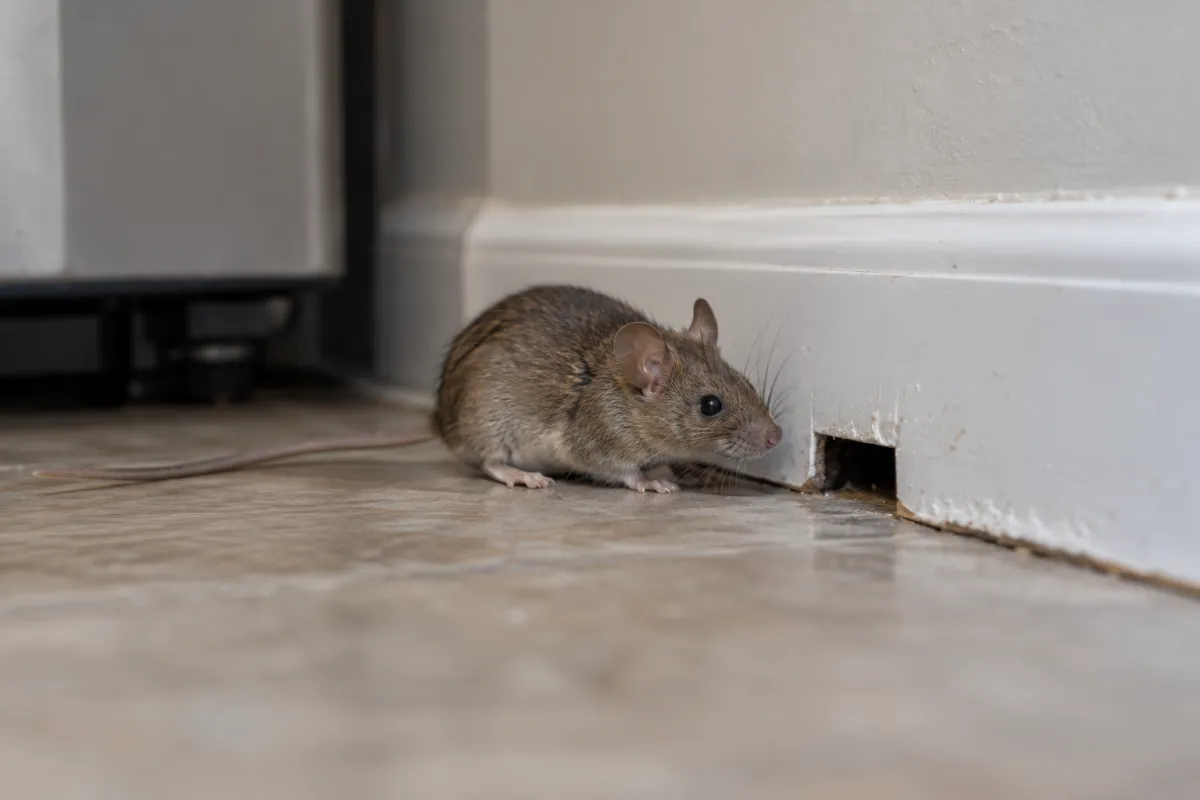
Getting rid of mice works best as a series of steps done in order. For what mice look like and how they live, see our main guide to mice control.
Step 1: Make sure it's mice
Check before you buy anything, as a mouse trap won't hold a rat. Mouse droppings are black, rod-shaped and around 3–6 mm long; anything much bigger points to rats. Fresh droppings are soft and moist. If every dropping you find is dry and hard, the mice may already have moved on.
Step 2: Find where they're active
Mice rarely travel far from their nest, but they nibble from many places rather than returning to one meal, so your traps need to cover the whole area they use.
Note every spot with droppings, gnawed packaging or dark grey smear marks. Mice prefer to run along walls and cupboard edges rather than across open floor, so those spots and the routes between them are where traps should go. Listening after dark, when mice are most active, can tell you which wall or ceiling they're using.
Step 3: Take away food and nesting material
A baited trap works best when it's the most interesting food around.
- Move dry food, pet food and bird seed into containers with tight lids.
- Throw away anything that has been nibbled.
- Clear crumbs from behind the cooker and fridge, and pick up pet bowls at night.
- Clear out stored cardboard, newspapers and old clothes, which mice use for nesting, or keep them in sealed plastic boxes.
Step 4: Set snap traps correctly
Snap traps, also called break-back traps, are the most dependable option at home.
- Use plenty. One or two traps are rarely enough. Set several in each area of activity, a metre or two apart.
- Get the angle right. Place each trap against the wall at a right angle to it, trigger end touching the skirting, so a mouse coming from either direction has to cross the trigger.
- Bait lightly. A pea-sized dab of nutty chocolate spread or a raisin pressed onto the trigger works well. Cheese is a comparatively poor bait. Too much bait lets a mouse feed without setting the trap off.
- Keep them out of reach of children and pets.
- Check every morning. Wear gloves, bag any catch for your outside bin and reset the trap in the same place.
Don't use glue traps. Since April 2024 it has been an offence for the public in England to use them, under the Glue Traps (Offences) Act 2022.
Step 5: If you use poison, keep it in a bait box
If you use an amateur-use rodenticide from a hardware store or garden centre:
- follow the product label exactly
- only put it inside a tamper-resistant bait box, never loose or in an open tray
- place boxes along the routes mice use, away from food preparation and out of reach of children and pets
- use several boxes rather than one, because mice feed from many places
- expect it to take several days to work
A poisoned mouse may die under the floor or inside a wall and leave a smell for a while. When you've finished, dispose of leftover bait as the label says.
Step 6: Seal the gaps they use
Catching mice without blocking their way in only makes room for the next ones. A mouse can squeeze through a gap of about 5 mm, so check where pipes and cables pass through walls and floors, and along the bottoms of external doors. Pack holes with wire wool embedded in quick-setting cement, as wire wool on its own can be pulled out. Fit metal strips to the bottoms of doors.
Step 7: Clean up
Once the mice have gone, clean every area they've used. Wear gloves, and wet droppings with disinfectant before wiping them up rather than sweeping or vacuuming. Our guide to cleaning up safely after mice goes through it in detail.
With the old droppings gone, any new ones will stand out straight away.
Step 8: Keep checking
Leave a few traps set for a couple of weeks after your last catch, and check the old hotspots every few days. Fresh droppings, new gnawing or scratching at night mean mice are still active or have found another way in, so go back to steps 4 and 6.
Step 9: Know when to call a professional
Mice are adaptable, highly mobile and breed rapidly, which can make them hard to control without training. It's time to get help if:
- you're still finding fresh droppings after two or three weeks of trapping
- you can hear mice in several rooms, in the loft or inside walls where you can't set traps
- the mice seem to be coming through from a neighbouring home
- you'd rather not handle traps and poison with children or pets at home
A professional pest controller is trained in mouse control and can use professional-use rodenticides that aren't available to the public. Our mice control service page explains what a treatment visit involves.