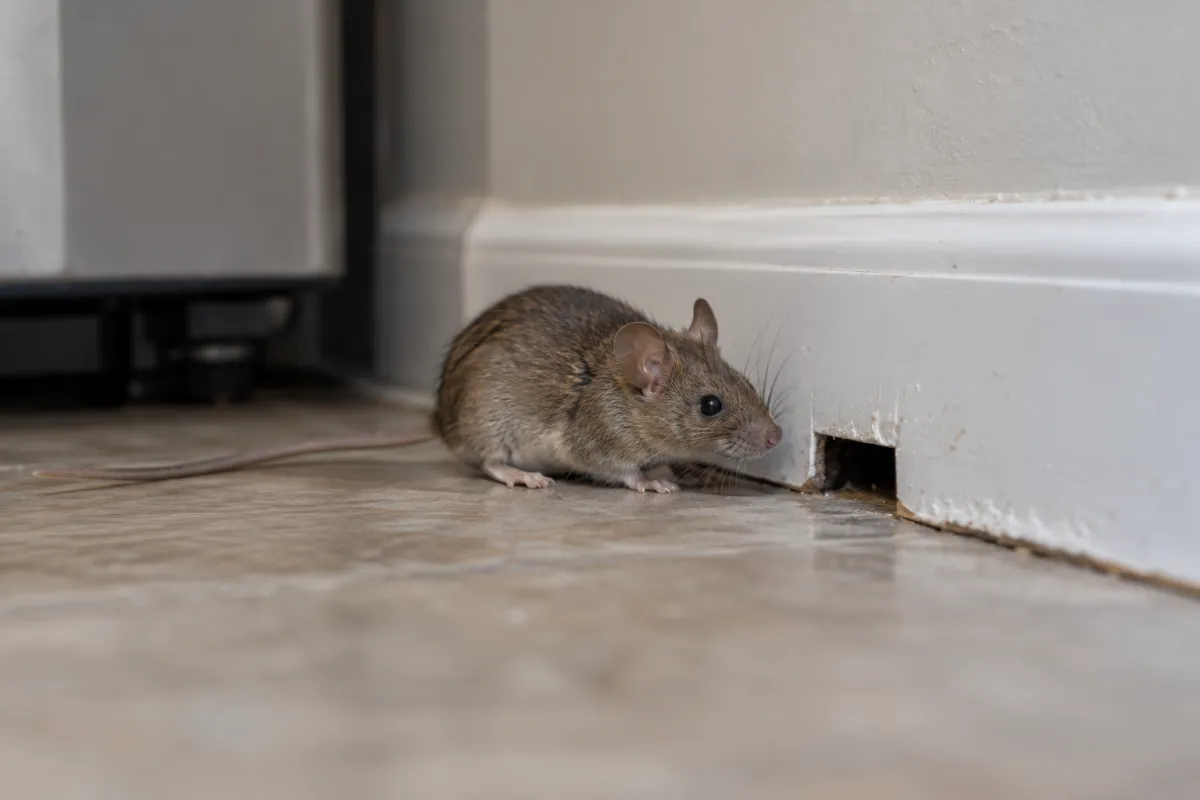
The house mouse, and sometimes the long-tailed field mouse, is found in buildings, where mice look for warmth, shelter, nesting sites and food.
Appearance
The house mouse has a body length of 60–90 mm, and its tail can add another 100 mm. Mice weigh less than 25 g, and their fur varies in colour between light brown and grey.
Diet, behaviour and habitat
Mice have an acute sense of hearing. They often use ultrasound to communicate and are particularly sensitive to any sudden noise.
Mice live in nests that they build out of cloth, wool and paper. Nests are often built inside houses, in places such as roof spaces, under floors or in wall cavities, wherever there is access to a good source of food, especially during the winter. Mice are mainly active at night and can often be heard running about as they search for food.
Mice are erratic, sporadic feeders. They nibble at many sources of food rather than taking repeated meals from any one item. They don't need free water to drink, as they normally get enough moisture from their food. Their favourite foods are cereal products, although they will eat almost anything.
Why control mice?
- Disease. Mice are known to spread nasty diseases to humans, such as salmonella and listeria, which can cause food poisoning.
- Damage. Mice have a compulsive need to gnaw to keep their incisor teeth worn down to a constant length. Electric cables, water and gas pipes, packaging and woodwork can all be seriously damaged by mice, and many electrical fires and floods have been blamed on them.
- Reputation. Mice can ruin an organisation's reputation. If clients and customers spot evidence of a rodent infestation in the premises you manage, they are unlikely to want to do business with you.
Signs of mouse activity
The presence of mice is usually given away by their dark droppings, or by damage to stored food in the larder, packaging or woodwork. Look out for:
- Droppings. Mouse droppings are usually black, rod-shaped and 3–6 mm long. Fresh droppings are soft and moist. Each mouse can leave around 80 droppings a day. Common places to find them are under the kitchen sink, around central heating boilers and in roof spaces.
- Smear marks. Dark grey marks left on surfaces by repeated contact with the oils in mouse fur.
- Nests. Nests are sometimes found indoors, for example in lofts, under floorboards or in airing cupboards.
- Gnawing. Mice gnaw constantly on materials such as wood, carpets, paper, pipes, cables and furniture. Check the food in your cupboards for damage.
How to prevent mice
- Seal up harbourage points, such as gaps around pipes and under sheds. Mice can squeeze through a gap as small as 5 mm, although mouse holes are normally 20–30 mm in diameter.
- Remove potential nesting sites by keeping yards and gardens clean and tidy, cutting back overgrown areas and clearing any piles of wood or debris.
- Cover any household waste that mice could get to, close dustbin lids and cover compost heaps.
How to get rid of mice
It's important to get rid of mice quickly. Mice are adaptable, highly mobile and breed rapidly, and this combination can make mouse control a difficult task for the untrained individual.
For any mouse infestation, we would always recommend contacting a professional pest control company. Professionals are trained in mouse control and have access to a range of professional-use rodenticides that are not available to the public. Our mice control service explains what a treatment involves.
Doing it yourself
If you decide to carry out the work yourself, you can buy amateur-use poisons and traps from a hardware store or garden centre. However, because of the way mice behave, traditional baiting and trapping often don't work, and a combination of rodenticides may be needed.
Break-back traps are an alternative to poison:
- Bait them with nutty chocolate, raisins or a similar attractive food. Surprisingly, cheese is a comparatively poor bait for mice.
- Place them close to signs of mouse activity.
- Set them close to the wall and at right angles to it, so the treadle can be set off by a mouse coming from either direction.
When placing poison or traps, make sure they are in a safe and secure place, out of reach of children and pets. For a fuller walk-through, see our step-by-step guide to getting rid of mice.
Proofing your home
Proofing every way in, as far as possible, will help to stop mice getting in. Block holes with wire wool embedded in quick-setting cement, and fit metal strips to doors to keep mice out.